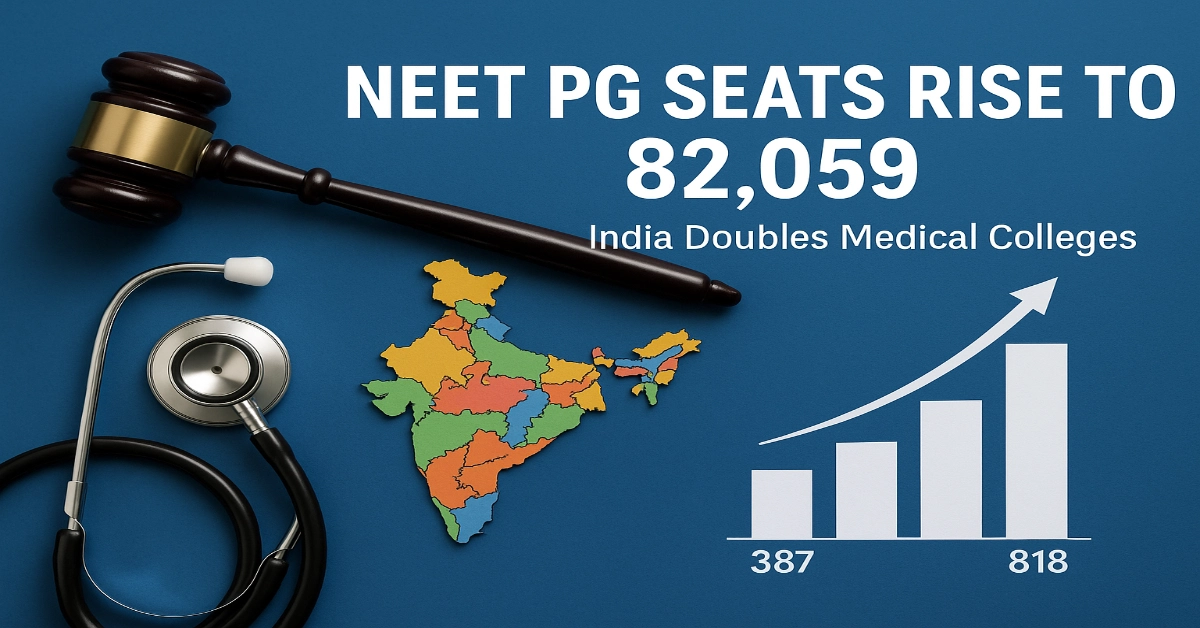
India’s medical education sector is witnessing a expansion over the last decade. The Union Minister of State for Health and Family Welfare, Shri Prataprao Jadhav, stated in a written reply in the Rajya Sabha that the number of medical colleges in the country has increased from 387 in 2014 to 818 as of now.
Along with this, Post Graduate (PG) medical seats have increased from 31185 to 82059, marking one of the biggest expansions in India’s NEET PG training capacity.
NEET PG Seats Rise to 82059
Shri Prataprao Jadhav informed the Rajya Sabha that India’s Post Graduate medical education capacity has undergone a remarkable expansion over the last decade. PG seats have increased from 31185 in 2014 to 82059 at present, a massive jump of over 50,000 seats.
This reflects a 163% increase in PG seats over the decade.
 Join NEET PG News 2026
 The Minister stated that this growth has been made possible through the establishment of new medical institutions, introduction of additional departments, and systematic creation of PG seats in existing colleges across the country.
This expansion aims to strengthen the specialist doctor workforce and improve access to advanced medical education nationwide.
India Doubles Medical Colleges
Medical Colleges in India Increased from 387 to 818. According to the Minister’s reply, India has more than doubled its medical colleges, reflecting aggressive infrastructure development and policy reforms in medical education.
Medical Colleges Accepting NEET PG (Category-wise Breakdown)
| Category | Number of Colleges |
|---|---|
| Government Medical Colleges | 289 |
| Private Medical Colleges | 223 |
| Deemed Universities | 45 |
| Total (Accepting NEET PG) | 557 |
The remaining colleges include newly approved institutions and colleges in various stages of operational readiness.
Key Benefits of the Expansion
1. Strengthening India’s Specialist Workforce
More PG seats mean higher availability of specialists in medicine, surgery, anaesthesia, paediatrics, and emerging specialties.
2. Enhanced Access to Medical Education
Several states, including Uttar Pradesh, Rajasthan, Tamil Nadu, Telangana, and Gujarat, have seen major growth in medical infrastructure.
3. Moving Toward WHO-Recommended Doctor Ratio
The surge in colleges and PG seats boosts India’s doctor-to-population ratio.
4. Better Healthcare in Rural & Aspirational Districts
Establishing new government colleges broadens access to tertiary healthcare and medical education.
Impact on NEET PG Aspirants
- Higher number of PG seats may moderately ease competition in upcoming NEET PG cycles.
- Rise in government colleges improves access to low-cost postgraduate training.
- More private and deemed institutions increase total seat availability, though fees vary widely.
The written reply by Union Minister of State Shri Prataprao Jadhav in the Rajya Sabha highlights the Government of India’s commitment to strengthening the medical education ecosystem.
With medical colleges rising from 387 to 818 and PG seats expanding from 31185 to 82059, India is taking decisive steps to build a larger, more skilled, and more equitable healthcare workforce.
NEET PG Counselling Guides 2026
NEET PG Deemed & Open State Quota eBook 2026
Deemed university & open state quota counselling guidance
MCC AIQ NEET PG Counselling Guide 2026 MOST POPULAR
50% AIQ counselling, choice filling & admission planning