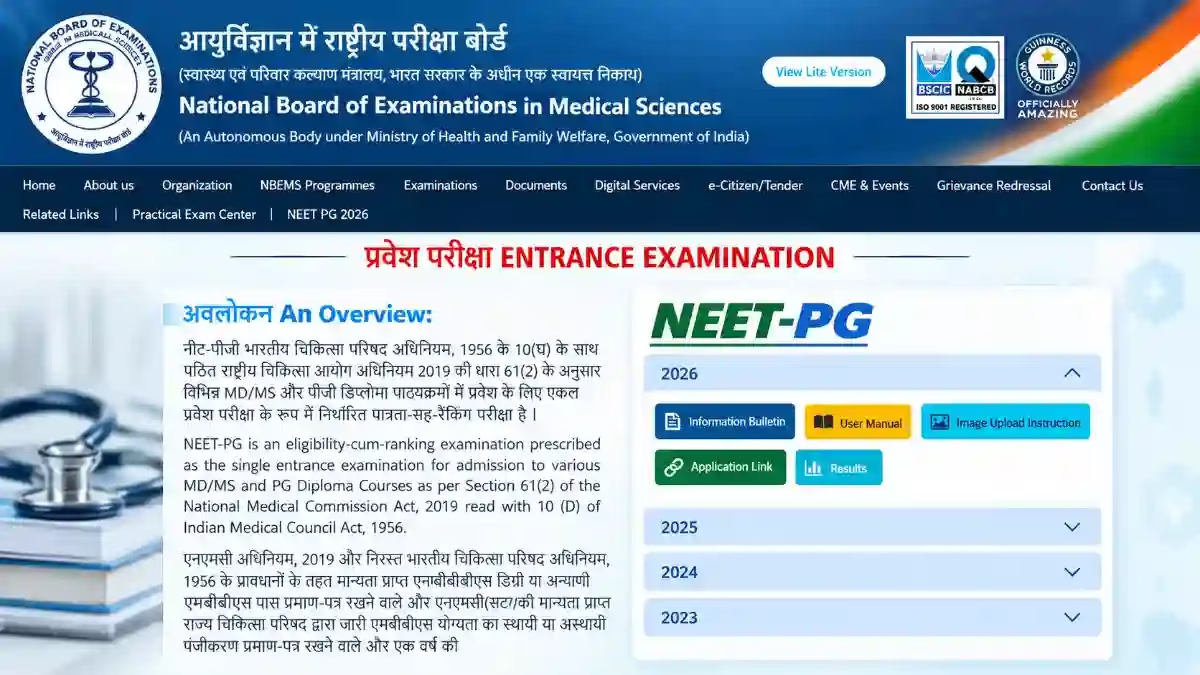
The National Board of Examinations in Medical Sciences (NBEMS) is an autonomous body under the Union Ministry of Health and Family Welfare, Government of India. Established in 1975 and registered as a society in 1982 under the Delhi Societies Registration Act, its core mandate is to standardise postgraduate medical education and conduct national-level examinations for medical specialists.
Quick Facts
A quick overview of NBEMS before going into governance and exam details:
| Feature | Details |
| Full Form | National Board of Examinations in Medical Sciences |
| Established | 1975 (registered as a society in 1982) |
| Type | Autonomous body |
| Parent Ministry | Ministry of Health & Family Welfare, Govt. of India |
| President | Dr. Abhijat Sheth |
| Vice-President & Hon. Executive Director | Prof. Minu Bajpai |
| Headquarters | Ansari Nagar, New Delhi – 110029 |
| Official Website | natboard.edu.in |
| Major Exams | NEET PG, NEET SS, NEET MDS, FMGE, PDCET, DNB CET SS, FET |
| Degrees Awarded | DNB, DrNB, FNB, PG Diplomas |
| Institutions Accredited for DNB | 700+ |
| Specialties Offered | 50+ |
History and Evolution of NBEMS
NBEMS was originally set up as the “National Board of Examinations” (NBE) in 1975, with a mandate limited to conducting postgraduate medical examinations independent of individual university systems. The objective was to improve the quality of medical education by establishing high, uniform postgraduate examination standards on an all-India basis while utilising existing hospital infrastructure for capacity building.
Over the following decades, as its role expanded to cover super-specialty programs, fellowships, screening tests for foreign graduates, and national entrance exams, the organisation was formally renamed to the National Board of Examinations in Medical Sciences to reflect its broader academic scope. It remains registered as a society, giving it a distinct legal identity separate from both the National Medical Commission (NMC) and individual state medical universities.
 Join NEET PG News 2026
 Key milestones:
- 1975 – National Board of Examinations (NBE) established to standardise postgraduate medical examinations.
- 1982 – Formally registered as a society under the Delhi Societies Registration Act.
- Subsequent years – Mandate expanded to include super-specialty (DrNB) and fellowship (FNB) programmes.
- Renamed to National Board of Examinations in Medical Sciences (NBEMS) to reflect its broader academic role.
- Present day – Conducts 9+ national exams and accredits 700+ training institutions across India.
Vision, Mission and Objective
NBEMS’s founding objective was to raise the quality of postgraduate medical education by setting high, uniform national examination standards, independent of individual university systems, while making full use of existing hospital infrastructure for training capacity.
- Vision: To be a national benchmark for standardised, competency-based postgraduate and post-doctoral medical education in India.
- Mission: To conduct fair, transparent and uniform examinations, and to accredit quality training institutions across the country.
- Objective: To enable intra-country and international comparability of medical specialists through a common evaluation mechanism.
NBEMS Office Locations
NBEMS operates from two locations in Delhi to manage its examination and accreditation functions:
| Campus | Address | Function |
| Ansari Nagar (Main Office) | Medical Enclave, Ansari Nagar, Mahatma Gandhi Marg, Ring Road, New Delhi – 110029 | Examinations, administration, governing body |
| Dwarka Campus | Dwarka-Dabri-Gurgaon Road, near District Court, Dwarka Sector 9, PSP Area, New Delhi – 110075 | Accreditation and allied functions |
NBEMS Departments
NBEMS functions through dedicated departments, each responsible for a specific part of the examination and training ecosystem:
| Department | Function |
| Accreditation | Accredits hospitals/institutions for DNB, DrNB, FNB and Diploma training |
| Examination Conduct | Organises entrance, exit and screening examinations |
| Examination Confidential & Results | Manages result processing and confidentiality of exam data |
| Training & Monitoring | Oversees trainee progress and training-hospital compliance |
| Administration | General administrative operations |
| Finance & Accounts | Fee management and financial operations |
| IT Section | Manages the examination and accreditation web portals |
Governing Body of NBEMS
NBEMS is governed by a Governing Body comprising senior medical academics and administrators, with authority over policy, curriculum and examination standards:
| Position | Name | Affiliation |
| President | Dr. Abhijat Sheth | Director of Medical Services, Apollo Hospital, Ahmedabad; also Chairman, NMC |
| Vice-President & Hon. Executive Director | Prof. Minu Bajpai | Formerly Head, Pediatric Surgery, AIIMS Delhi |
| Vice President | Prof. Nikhil Tandon | Professor & Head, Endocrinology & Metabolism, AIIMS Delhi |
| Vice President | Dr. Shiva Kant Misra | Director & CEO, Shivani Hospital and IVF, Kanpur |
| Vice President | Dr. C Mallikarjuna | Managing Director, Asian Institute of Nephrology and Urology, Hyderabad |
NBEMS Contact Details
Official contact information for candidate queries, complaints, or exam-related support.
| Particulars | Details |
| Office Address | Ring Road, Mahatma Gandhi Marg, Medical Enclave, Ansari Nagar East, New Delhi – 110029 |
| Contact Number | +91-11-45593000 |
| Helpdesk Email | helpdesknbeexam@natboard.edu.in |
| Working Hours | 9:30 AM – 6:00 PM, Monday to Friday |
Before reaching out, candidates should:
- Check the relevant exam’s official notification/FAQ page first, as many queries are already addressed there.
- Keep their registration/roll number handy when writing to the helpdesk.
- Use the Communication Web Portal for grievances that need to be tracked over time.
Legal Status and Autonomy
NBEMS operates as a registered society under its own Memorandum of Association and By-laws, giving it functional autonomy to design curricula, conduct exams, and accredit training institutions – while remaining under the administrative oversight of the Ministry of Health & Family Welfare.
- Registered as an autonomous society, distinct from NMC and state universities.
- Functions under the administrative oversight of the Ministry of Health & Family Welfare.
- Has independent authority to design curricula, conduct exams and grant accreditation.
- A proposal to merge NBEMS into NMC as a new “Board of Examinations in Medical Sciences (BEMS)” has faced opposition from medical bodies and remains under consultation as of the latest available update.
NBEMS vs NMC vs MCC: Key Differences
Candidates often confuse NBEMS with the National Medical Commission (NMC) and the Medical Counselling Committee (MCC), since all three appear at different stages of the medical education and admission journey:
| Aspect | NBEMS | NMC | MCC |
| Full Form | National Board of Examinations in Medical Sciences | National Medical Commission | Medical Counselling Committee |
| Type | Autonomous examination-conducting society | Statutory regulatory body | Counselling body under DGHS |
| Primary Role | Conducts PG/exit exams (NEET PG, NEET SS, FMGE, GPAT) and awards DNB/DrNB/FNB | Regulates medical education, colleges, and practitioner registration | Conducts All India Quota seat counselling for MBBS/BDS/PG seats |
| Parent Ministry | Ministry of Health & Family Welfare | Ministry of Health & Family Welfare | Directorate General of Health Services (DGHS) |
| Legal Basis | Registered society (Delhi Societies Registration Act) | Statutory body under the NMC Act, 2019 | Functions under DGHS, not a separate statutory body |
| Relationship to Each Other | Coordinates with NMC on curriculum and recognition; not under NMC’s direct control | Approves NBEMS-conducted qualifications for registration | Uses NBEMS/NEET results to allot seats |
NBEMS Coordination with Other Regulatory Bodies
NBEMS does not function in isolation – it coordinates regularly with other national regulatory bodies on curriculum, recognition and counselling matters:
| Body | Area of Coordination |
| National Medical Commission (NMC) | Curriculum alignment, recognition of MBBS/PG qualifications |
| Medical Counselling Committee (MCC) | All India Quota seat counselling for NEET PG/SS admissions |
| Dental Council of India (DCI) | Recognition of dental qualifications (NEET MDS, FDG ST) |
| Ministry of External Affairs (MEA) | Verification for foreign medical/dental graduates (FMGE, FDG ST) |
| Pharmacy Council of India (PCI) | Coordination on pharmacy exit examinations |
Scope of Functions of NBEMS
NBEMS carries out four core functions across India’s postgraduate medical education ecosystem:
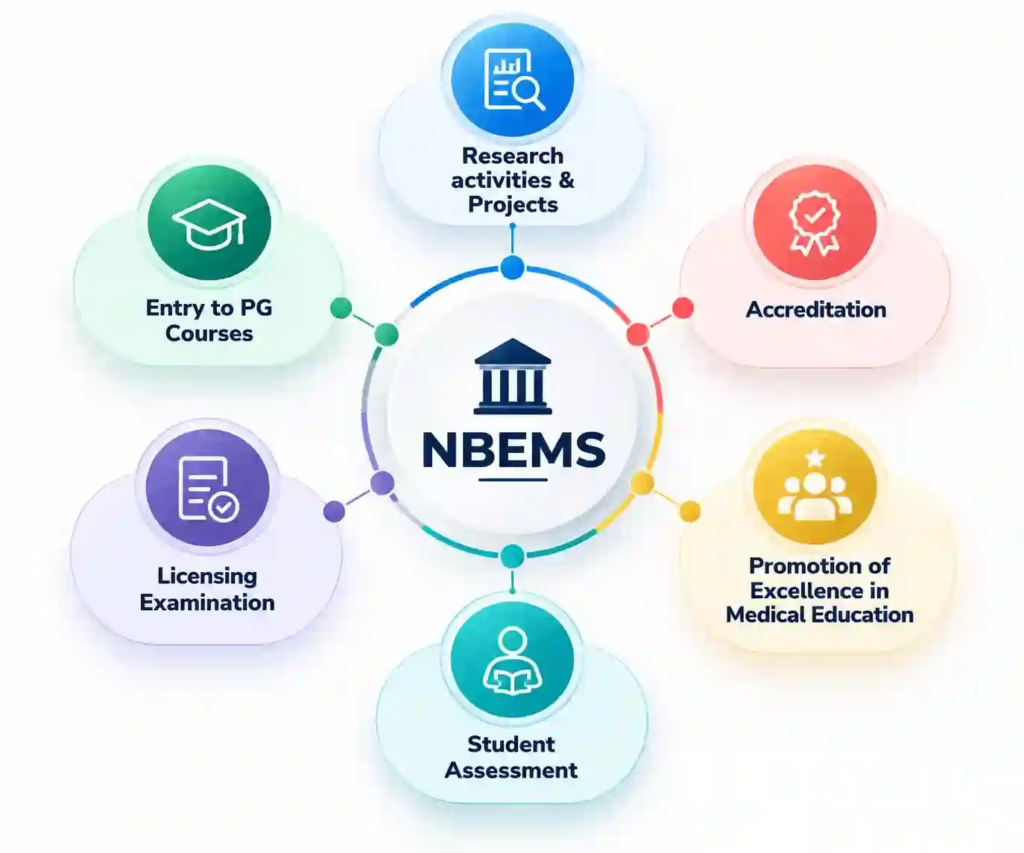
- Conducting Examinations – entrance tests (NEET PG, NEET SS, NEET MDS), licensing/screening tests (FMGE, FDG ST), and exit exams for DNB/DrNB/FNB trainees.
- Accreditation of Institutions – hospitals and medical colleges are accredited to run DNB/DrNB/FNB training programs, including under the Joint Accreditation Programme, which pairs primary and secondary hospitals to expand training capacity.
- Curriculum Development – competency-based curricula for DNB and fellowship courses are designed and periodically revised in consultation with subject experts.
- Continuing Medical Education (CME) – NBEMS promotes structured CME activity for practising specialists to support lifelong learning.
Exams Conducted by NBEMS
NBEMS conducts nine major national-level medical and dental examinations, grouped by purpose:
| Exam | Purpose |
| NEET PG | Admission to MD/MS/PG Diploma courses |
| NEET MDS | Admission to MDS postgraduate dental courses |
| NEET SS | Admission to DM/MCh super-speciality courses |
| FMGE | Licensing exam for Indian/OCI candidates with a foreign medical degree |
| PDCET | Entry for diploma holders into DNB Broad Speciality courses |
| DNB CET (SS) | Entrance for DNB Super Speciality courses |
| DNB Dental Speciality | Entrance for DNB postgraduate dental programs |
| FET | Entrance for FNB post-doctoral fellowship programs |
| FDG ST | Licensing exam for Indian/OCI candidates with a foreign dental degree |
NEET PG and DNB admissions ultimately lead candidates into specialty training – for related specialty-wise seat and admission details, see the guides for Pediatrics, Radiology, General Medicine, Obstetrics and Gynecology, Dermatology, Anesthesiology, Psychiatry, General Surgery, ENT, Orthopedics, and Ophthalmology.
NBEMS Exam Calendar 2026
Here is the table of the NBEMS Exam Calendar 2026:
| Exam | 2026 Date | Status |
| GPAT 2026 | March 7 | Completed (Result: April 7) |
| NEET MDS 2026 | May 2 | Completed |
| NEET PG 2026 | August 30 | Completed (Result expected by Sept 30) |
| FMGE June 2026 | June 28 | Completed |
| NEET SS 2026 | December 11–12 (tentative) | Upcoming |
| FMGE December 2026 | January 9, 2027 (tentative) | Upcoming |
How to Apply for NBEMS Exams
Since NBEMS conducts multiple exams (NEET PG, NEET MDS, NEET SS, FMGE, GPAT), the application process follows a broadly similar pattern across all of them, with exam-specific eligibility and fee differences:
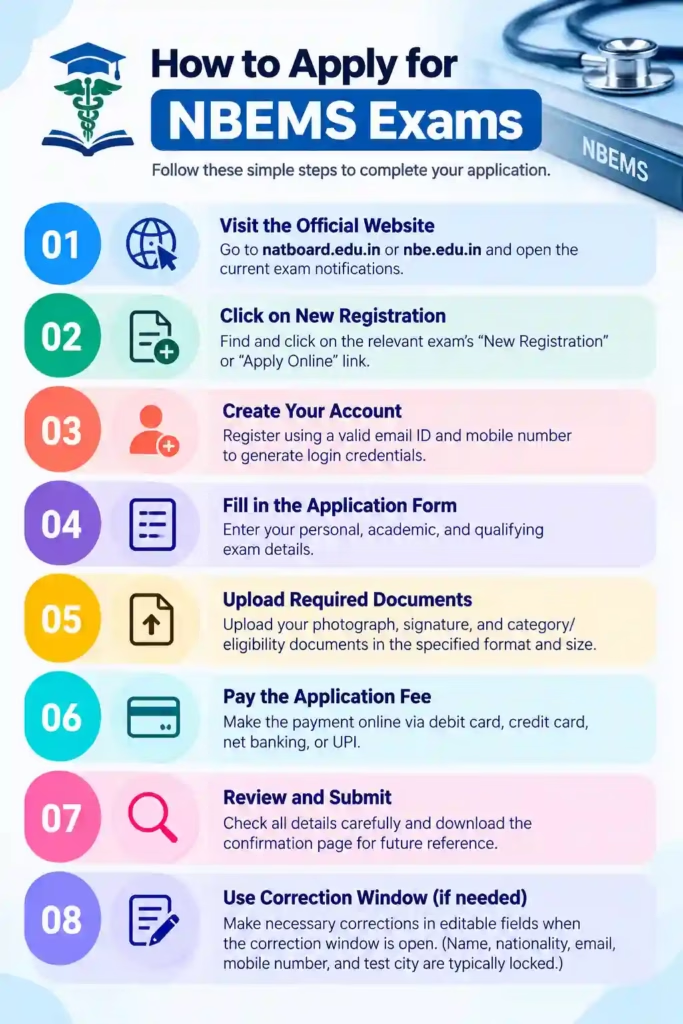
Steps to Apply:
- Visit the official NBEMS portal at natboard.edu.in or nbe.edu.in, depending on which exam’s registration window is active
- Locate the relevant exam’s “New Registration” or “Apply Online” link under the current notifications section
- Register using a valid email ID and mobile number to generate login credentials
- Fill in personal, academic, and qualifying exam details as required
- Upload scanned photograph, signature, and category/eligibility documents in the specified format and size
- Pay the application fee online via debit card, credit card, net banking, or UPI
- Review the submitted form and download the confirmation page for future reference
- Use the correction window (when opened) to fix errors in editable fields – name, nationality, email, mobile number, and test city are typically locked
Documents Commonly Required
- MBBS/BDS/B.Pharm degree certificate or provisional pass certificate
- Internship completion certificate (for NEET PG/MDS)
- State Medical/Dental Council or NMC registration
- Valid photo ID (Aadhaar, passport, voter ID, or driving licence)
- Category certificate, where applicable
Degrees and Qualifications Awarded by NBEMS
NBEMS grants postgraduate and super-specialty qualifications recognised as equivalent to university degrees:
| Qualification | Equivalent To | Details |
| DNB (Diplomate of National Board) | MD/MS | Broad specialty postgraduate qualification, offered across 50+ disciplines |
| DrNB (Doctorate of National Board) | DM/MCh | Super-specialty qualification, 3-year programme (or integrated 6-year from MBBS in select disciplines) |
| FNB (Fellow of National Board) | Post-doctoral fellowship | Awarded after FET in select specialties |
| PG Diplomas | – | Diploma-level postgraduate qualifications in select subjects |
DNB Broad Specialty – Course Duration
Course length for DNB Broad Specialty depends on the entry route a candidate takes:
| Entry Route | Duration |
| Post-MBBS (direct entry) | 3 years |
| Post-Diploma (candidates with a recognised 2-year PG Diploma) | 2 years |
| Integrated 6-year programme (select disciplines, direct from MBBS) | 6 years |
Stipend for DNB Trainees
DNB trainees in accredited institutions receive a monthly stipend for the full duration of training, including eligible leave, as per NBEMS guidelines.
- Stipend is not paid beyond 36 months for a 3-year programme, or beyond 24 months for a 2-year programme, if training is extended due to excess leave.
- Stipend amounts are set by the accredited hospital/institution, not centrally fixed by NBEMS.
NBEMS Joint Accreditation Programme
A flagship NBEMS initiative that pairs a primary training hospital with a nearby secondary institution to jointly offer DNB/Diploma seats, expanding postgraduate training capacity beyond standalone hospitals. Each pairing specifies the accredited specialties, the number of seats, and the geographical distance between the two institutions, and the accredited list is notified afresh for every admission session.
NBEMS by the Numbers
Key figures that reflect the scale of NBEMS’s role in India’s postgraduate medical education system:
| Metric | Approx. Figure |
| Institutions accredited for DNB programs | 700+ |
| Broad and super-specialty disciplines offered | 50+ |
| DNB qualifications conferred annually | 20,000+ candidates |
| Office locations | 2 (Ansari Nagar & Dwarka, New Delhi) |
Grievance Redressal at NBEMS
NBEMS maintains separate grievance mechanisms for trainees and for accredited hospitals, to resolve training and examination-related disputes.
- Grievance Redressal Committee (GRC) for NBEMS Trainees – handles complaints from candidates undergoing DNB/DrNB/FNB training.
- Grievance Redressal Committee for Accredited Hospitals – handles complaints and compliance issues raised by training institutions.
Legal Recognition of NBEMS Qualifications
DNB, DrNB and FNB qualifications awarded by NBEMS are approved by the Government of India and were included in the First Schedule of the (repealed) Indian Medical Council Act, 1956, giving them legal standing equivalent to corresponding university degrees (MD/MS/DM/MCh) for registration and practice purposes.
Official NBEMS Web Portals
NBEMS operates separate online portals for different candidate and institution needs – always use the correct one for your purpose.
- natboard.edu.in – Main website: notifications, exam schedules, circulars, downloads.
- accr.natboard.edu.in – Accreditation portal for hospitals/institutions applying for DNB/DrNB/FNB/Diploma accreditation.
- nbe.edu.in – Registration and application windows for NEET PG, NEET SS, NEET MDS, FMGE and other exams (linked from the main site during active cycles).
- Communication Web Portal – For candidate queries, grievances and correspondence tracking.
Eligibility Criteria – Key NBEMS Exams
A quick eligibility snapshot for the most-searched NBEMS exams:
| Exam | Minimum Eligibility |
| NEET PG | MBBS from a recognised university + completed internship + State Medical Council registration |
| NEET MDS | BDS from a recognised university + completed internship + State Dental Council registration |
| NEET SS | MD/MS/DNB + permanent MBBS registration |
| FMGE | Indian citizen/OCI with a foreign medical degree recognised by the Indian Embassy in that country |
| PDCET | MBBS + completed internship + State Medical Council registration |
Organizational Structural Design of NBEMS
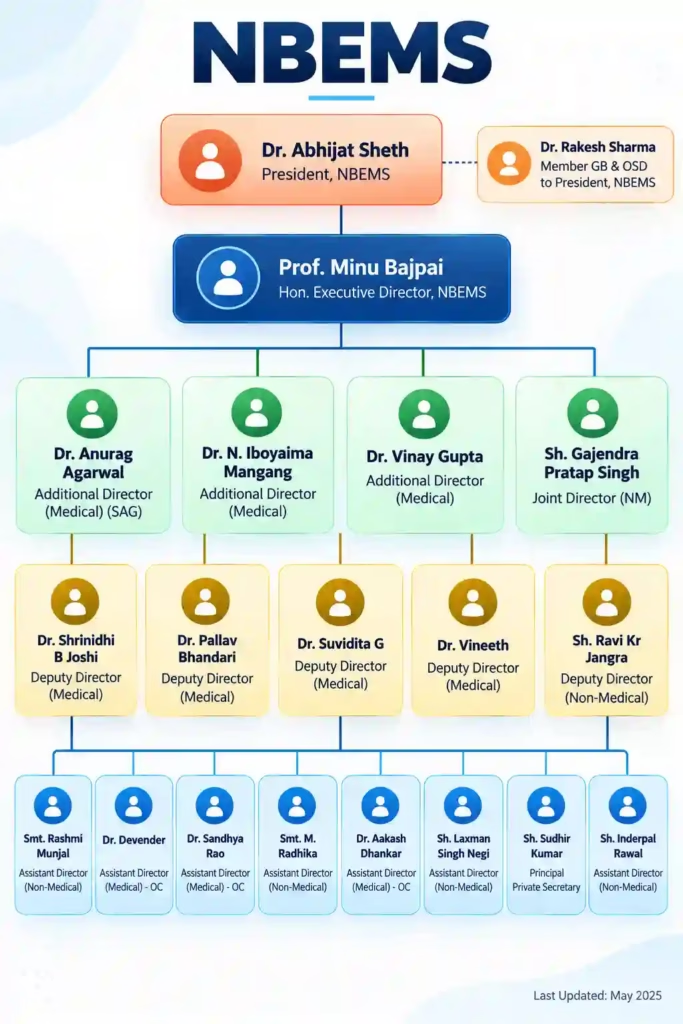
NBEMS functions as an autonomous organization under the administrative aegis of the Ministry of Health & Family Welfare, Government of India. As an independent entity, it operates with substantial self-governance while maintaining policy alignment with broader national health education goals.
1. Governance Framework
NBEMS is governed by a high-level Governing Body, the apex decision-making authority of the organization, comprising:
- President – currently Dr. Abhijat Sheth, associated with Apollo Hospital.
- Executive Director — manages day-to-day operations and strategic initiatives.
- Institutional Representatives – senior members from accredited medical institutions and public health administration, who contribute to policy-making and academic oversight.
The Governing Body holds the authority to formulate, review, and amend the organization’s strategic direction, in alignment with national healthcare education policy.
2. Legal and Structural Autonomy
NBEMS is registered as a society, giving it the flexibility to operate under its Memorandum of Association (MoA) and By-laws, independently developed and approved by its Governing Body. While it functions under the Ministry’s administrative oversight, it retains the autonomy to:
- Design and update academic programs
- Conduct national-level examinations
- Accredit training institutions
- Establish internal administrative procedures
3. Location and Infrastructure
NBEMS is headquartered in New Delhi, from where it administers its academic, regulatory, and examination functions across India.
4. Coordination with Regulatory Bodies
NBEMS works in collaborative alignment with key medical regulatory authorities, especially the National Medical Commission (NMC) – the statutory body that replaced the erstwhile Medical Council of India (MCI):
- NBEMS follows NMC-approved curricula and academic standards.
- It adheres to NMC regulations for the recognition of qualifications.
- It coordinates with state and central institutions for implementing postgraduate medical education frameworks.
- Despite this coordination, NBEMS remains institutionally distinct from NMC and is not under its direct control.
5. Recent Policy Developments and Structural Proposals
The Ministry of Health & Family Welfare has proposed legislative reforms aimed at integrating NBEMS into the NMC framework:
- A proposal exists to establish a new entity titled the “Board of Examinations in Medical Sciences (BEMS)” as the fifth autonomous board within NMC, effectively replacing NBEMS.
- Under this proposed structure, NBEMS’s functions – including conducting the National Exit Test (NEXT) – would become part of NMC’s broader mandate under the NMC Act, 2019.
- The proposal has faced widespread opposition from medical associations and NBEMS-accredited institutions, over concerns of autonomy, academic freedom, and operational efficiency.
- As of the latest available update, the reform remains under consultation, and NBEMS continues to function independently while discussions between stakeholders and the government are ongoing.
6. Summary of Current Status
| Aspect | Status |
| Legal Status | Autonomous Society under MoHFW |
| Governing Authority | Governing Body led by President and Executive Director |
| Affiliation with NMC | Not under NMC; operates independently |
| Key Responsibility | National-level postgraduate medical examinations |
| Proposed Reform | Integration as BEMS under NMC (pending decision) |
This structural design highlights NBEMS’s unique position as a semi-regulatory, examination-conducting authority that balances autonomy with government alignment. While the future structure may evolve depending on legislative decisions, NBEMS remains a critical institution in India’s postgraduate medical education ecosystem.
GPAT – NBEMS’s Pharmacy Examination
Beyond medical and dental exams, NBEMS also administers the Graduate Pharmacy Aptitude Test (GPAT) on behalf of the Pharmacy Council of India (PCI) – a role it has held since 2024, after GPAT moved from the National Testing Agency (NTA) to NBEMS.
| Feature | Details |
| Full Form | Graduate Pharmacy Aptitude Test |
| Conducted By | NBEMS, on behalf of the Pharmacy Council of India (PCI) |
| Purpose | Admission to M.Pharm programmes |
| Mode | Computer-Based Test (CBT) |
| Duration | 3 hours (180 minutes) |
| Eligibility | B.Pharm (or equivalent); final-year B.Pharm candidates and lateral entrants are also eligible |
| Approx. Seats Covered | 39,000+ M.Pharm seats across 800+ institutions in India |
| Score Validity | 3 years |
| Official Website | natboard.edu.in |
NBEMS Diploma Courses
Apart from DNB (Broad Specialty) and DrNB (Super Specialty), NBEMS separately administers postgraduate Diploma courses – a distinct, generally shorter track recognised alongside DNB qualifications.
- Diploma courses run for a duration shorter than the standard 3-year DNB Broad Specialty programme.
- Candidates who complete an NBEMS-recognised 2-year PG Diploma can subsequently pursue a 2-year Post-Diploma DNB in the same specialty, instead of the full 3-year route.
- NBEMS conducts a separate NBEMS Diploma Final Examination for candidates completing these diploma programmes.
- Diploma courses are offered at NBEMS-accredited hospitals/institutions, following the same accreditation process used for DNB training.
Frequently Asked Questions (FAQs)
What is the role of NBEMS in NEET PG?
NBEMS is the official conducting body responsible for organising the NEET PG examination in India.
Where can I check my NEET PG result released by NBEMS?
NEET PG results are published on the NBEMS official site: natboard.edu.in under the “Results” section.
How can I contact NBEMS for NEET PG-related queries?
You can reach NBEMS through their official helpdesk, email (helpdesknbeexam@natboard.edu.in), or their helpline numbers available on the official website.
What is the eligibility criteria for NEET PG as per NBEMS?
Candidates must hold an MBBS degree and a valid registration certificate from MCI/NMC or the State Medical Council.
What are the NEET PG qualifying marks set by NBEMS?
NBEMS releases the qualifying cut-off marks category-wise each year after the exam results.
NEET PG Counselling Guides 2026
NEET PG Deemed & Open State Quota eBook 2026
Deemed university & open state quota counselling guidance
MCC AIQ NEET PG Counselling Guide 2026 MOST POPULAR
50% AIQ counselling, choice filling & admission planning